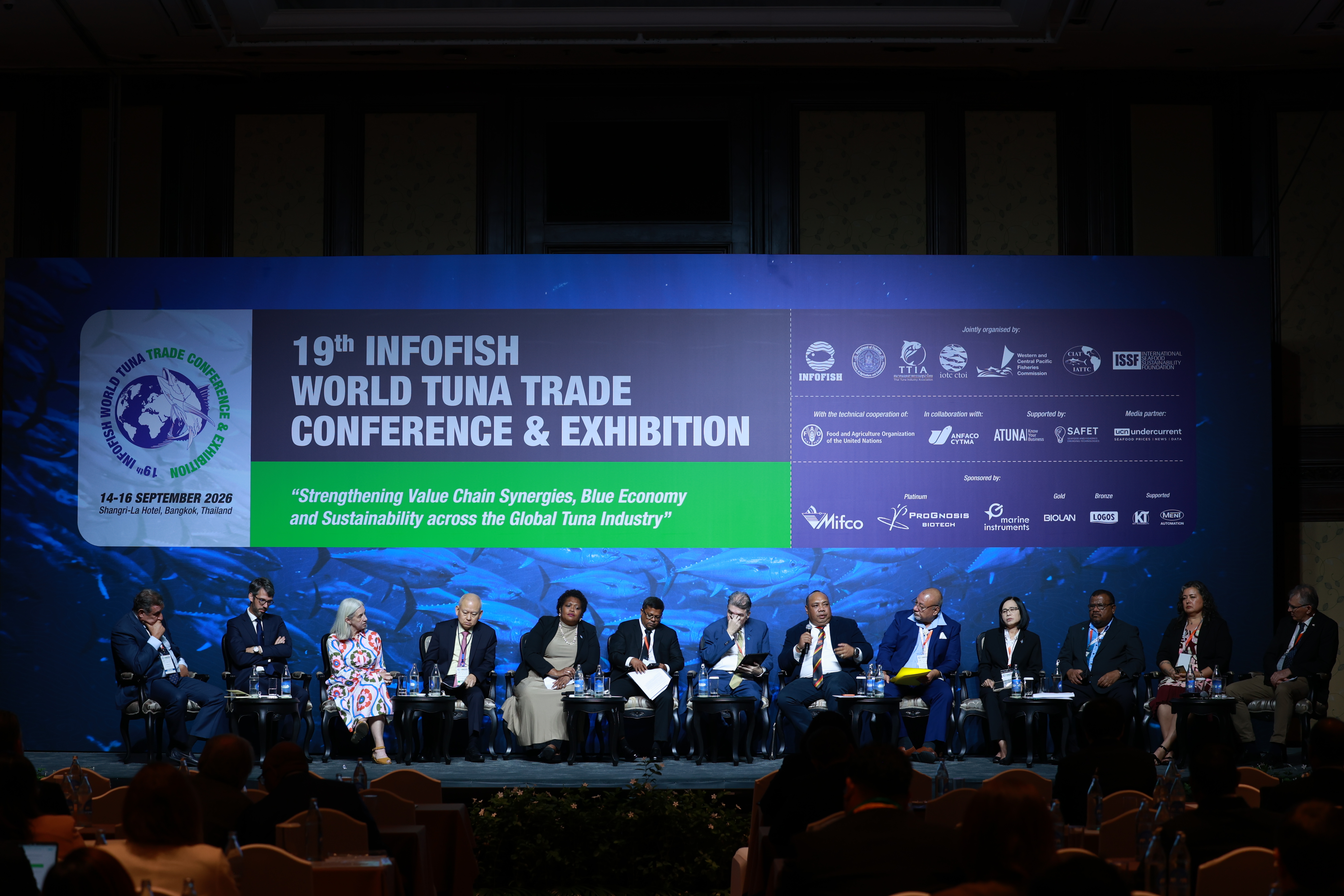
Bangkok, Thailand – The WCPFC Executive Director, Ms Rhea Moss-Christian, joined global fisheries and industry leaders at the 19th INFOFISH World Tuna Trade Conference & Exhibition (TUNA 2026), held from 14–16 September 2026 at the Shangri-La Hotel, Bangkok, Thailand.
WCPFC was one of the conference's joint organisers, alongside INFOFISH, the Department of Fisheries Thailand, the Thai Tuna Industry Association, the Indian Ocean Tuna Commission, the Inter-American Tropical Tuna Commission (IATTC) and the International Seafood Sustainability Foundation, with technical cooperation from the Food and Agriculture Organization of the United Nations (FAO). The conference ran under the theme "Strengthening Value Chain Synergies, Blue Economy and Sustainability across the Global Tuna Industry."
On the opening day, Ms Moss-Christian took part in the flagship Special Leaders' Dialogue on "Leadership, Sustainability and the Future of Global Tuna Trade" and spoke in Session 1: Global Tuna Industry Outlook, Markets & Strategic Trends.
Special Leaders' Dialogue: RFMOs as platforms for action and accountability
Leaders were asked to assess how effectively current governance turns Member commitments into measurable conservation outcomes, and to name the most significant institutional challenges.
Ms Moss-Christian described the RFMO platform as a tool for both compelling Member action and holding Members accountable for it. She pointed to WCPFC's management of Pacific bluefin tuna, led by the Commission's Northern Committee, as an example.
Just over ten years ago, the Pacific bluefin stock had fallen to 2.6% of unfished levels. Closer cooperation between WCPFC and IATTC, scientific rigour and decisive management action by Members produced a two-stage rebuilding plan:
- The first rebuilding target, due by 2024, was met in 2017 – seven years early.
- The second target, due by 2034, was met in 2021 – more than ten years early.
"This was achieved through sacrifice and a willingness to cooperate toward a positive outcome that would be beneficial for all stakeholders in the long term," Ms Moss-Christian said.
With the stock now more stable, she noted, Members face a different challenge: how to allocate catch. While a more welcome problem than the deep catch cuts of a decade ago, it will demand the same level of cooperation that made the rebuilding a success.
More broadly, she identified decision-making processes as the major institutional challenge. WCPFC's consensus-based model has delivered significant progress, but it will be harder to sustain as the stakes rise for Members and as external pressures push RFMOs to reach better decisions in shorter time frames. She cited the BBNJ Agreement as one such pressure, which may require faster and more robust decision-making by RFMOs whose memberships often overlap.
"This will require strong coordination and transparency at national level to ensure that actions across multiple ocean management forums are consistent and supportive of national interests," she said.
Session 1: Climate change and the strategic outlook for the WCPO
In the opening technical session on the global tuna industry outlook, markets and strategic trends, Ms Moss-Christian addressed how climate change is reshaping tuna management and supply in the Western and Central Pacific Ocean (WCPO).
She explained that the data indicate tuna stocks in the WCPO will shift eastward and predominantly into the high seas. Coastal States and Territories may therefore see biomass in their exclusive economic zones decline, in some cases significantly, with knock-on effects for revenues and related benefits.
The States likely to be most affected, she said, need to consider their future role in these fisheries: which partners will be necessary and relevant, and what legal and other arguments can limit the harm from fewer fish in their waters.
"These aren't 'what if' scenarios; they are 'when' scenarios, so planning needs to be underway now," Ms Moss-Christian said.
On cooperation between RFMOs, coastal States and industry, she highlighted increased data sharing and transparency as essential to helping stakeholders prepare for and respond to changes both on the water and in the market.
Strengthening partnerships across the tuna value chain
TUNA 2026 brought together ministers, senior officials, RFMOs, industry leaders, buyers, financiers and international organisations from across the global tuna value chain. WCPFC's participation as a joint organiser reflects the Commission's commitment to working with governments, industry and partners to keep the region's tuna stocks sustainable in a changing ocean.
Further information on the conference is available at tuna.infofish.org.